when Albions Need Is Greatest Arthur Will Rise Again
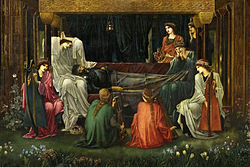
Male monarch Arthur's messianic render is a mythological motif in the legend of King Arthur, which claims that he will i mean solar day render in the office of a messiah to save his people. It is an example of the king asleep in mount motif. Male monarch Arthur was a legendary 6th-century British king. Few historical records of Arthur remain, and at that place are doubts that he e'er existed, just he accomplished a mythological stature that gave rising to a growing literature well-nigh his life and deeds.
Origins [edit]
The possibility of Arthur's return is showtime mentioned past William of Malmesbury in 1125: "But Arthur'southward grave is nowhere seen, whence antiquity of fables nonetheless claims that he will return."[1] In the "Miracles of St. Mary of Laon" (De miraculis sanctae Mariae Laudunensis), written by a French cleric and chronicler named Hériman of Tournai in c. 1145, just referring to events that occurred in 1113, mention is made of the Breton and Cornish belief that Arthur still lived.[2] [3] As Constance Bullock-Davies demonstrated, various non-Welsh sources indicate that this belief in Arthur's eventual messianic return was extremely widespread amongst the Britons from the 12th century onwards. How much earlier than this it existed is still debated.[4] It did, in fact, remain a powerful aspect of the Arthurian fable through the medieval period and beyond. So John Lydgate in his Fall of Princes (1431–38) notes the conventionalities that Arthur "shall resorte as lord and sovereyne Out of fayrye and regne in Breteyne" and Philip Two of Spain plain swore, at the time of his matrimony to Mary I of England in 1554, that he would resign the kingdom if Arthur should render.[five]
A number of locations were suggested for where Arthur would actually return from. The earliest-recorded suggestion was Avalon. In his twelfth-century Historia Regum Britanniae, Geoffrey of Monmouth asserted that Arthur "was mortally wounded" at Camlann only was then carried "to the Island of Avallon (insulam Auallonis) to exist cured of his wounds", with the implication that he would at some point be cured and return therefrom made explicit in Geoffrey's later Vita Merlini.[6] Another tradition held that Arthur was awaiting his return beneath some mountain or loma. First referenced by Gervase of Tilbury in his Otia Imperialia (c.1211), this was maintained in British sociology into the 19th century and R.S. Loomis and others have taken it as a tale of Arthur's residence in an clandestine (as opposed to an overseas) Otherworld.[7] Other less common concepts include the idea that Arthur was absent leading the Wild Hunt, or that he had been turned into a crow or raven.[8]
Influence [edit]
Medieval politics [edit]
The influence of Arthur's legend is not confined to novels, stories, and films; the legend of Arthur's messianic return has often been politically influential. On the one paw, information technology seems to take provided a means of rallying Welsh resistance to Anglo-Norman incursions in the 12th century and later. The Anglo-Norman text Description of England recounts of the Welsh that "openly they go about proverb,... / that in the end, they volition have it all; / by means of Arthur, they will have it back... / They volition call it Britain once more."[9] It may be that such references every bit this reflect a Welsh conventionalities that Arthur ought to be associated with the "Mab Darogan" ("Son of Prophecy"), a messianic figure of the Welsh prophetic tradition who would repel the enemies of the Welsh and who was oftentimes identified with heroes such every bit Cadwaladr, Owain Lawgoch and Owain Glyndŵr in Welsh prophetic poesy.[10] Even so, equally Oliver Padel has noted, no case of a Welsh prophetic verse telling of Arthur'due south render to miscarry the enemies of the Welsh from Britain has survived, which some have seen as troubling and a reason for caution: we must rely on non-Welsh texts (such every bit the above) for the notion that this was a widespread belief amongst the Welsh from the mid-12th century onwards, along with more than debatable evidence such every bit Henry VII's attempts to associate himself with Arthur when taking the throne, discussed beneath.[eleven]
On the other mitt, the notion of Arthur's eventual render to rule a united United kingdom was adopted past the Plantagenet kings to justify their rule.[12] Once Male monarch Arthur had been safely pronounced expressionless, in an endeavour to deflate Welsh dreams of a genuine Arthurian return, the Plantagenets were so able to brand ever greater use of Arthur as a political cult to support their dynasty and its ambitions. And so, Richard I used his status as the inheritor of Arthur's realm to shore upward foreign alliances, giving a sword reputed to be Excalibur to Tancred of Sicily.[13] Similarly, "Round Tables"—jousting and dancing in faux of Arthur and his knights—occurred at least eight times in England between 1242 and 1345, including one held by Edward I in 1284 to gloat his conquest of Wales and consequent "reunification" of Arthurian Britain.[xiv] The Galfridian claim that Arthur conquered Scotland was as well used by Edward I to provide legitimacy to his claims of English suzerainty over that region.[15]
Post-medieval politics [edit]
The influence of Rex Arthur on the political machinations of England's kings was not confined to the medieval period: the Tudors also establish it expedient to make use of Arthur. In 1485, Henry Vii marched through Wales to accept the English throne under the imprint of the Arthurian Red Dragon, he commissioned genealogies to show his putative descent from Arthur, and named his first-born son Arthur.[sixteen] Later on, in the reigns of Henry VIII and Elizabeth, Arthur's career was influential again, now in providing testify for supposed historical rights and territories in legal cases that pursued the crown's interests.[17]
Whilst the potential for such political usage—wherein the reality of Geoffrey's Arthur and his broad-ranging conquests was accustomed and proclaimed by English language antiquarians and thus utilized by the crown—naturally declined after the attacks on Geoffrey'southward Historia by Polydore Vergil and others,[xviii] Arthur has remained an occasionally politically potent figure through to the present era. In the 20th century, a comparison of John F. Kennedy and his White Firm with Arthur and Camelot, made past Kennedy'due south widow, helped consolidate Kennedy's posthumous reputation, with Kennedy even becoming associated with an Arthur-like messianic return in American folklore.[xix]
Modern adaptations [edit]
This idea of Arthur'due south eventual return has proven attractive to a number of modern writers. John Masefield used the idea of Arthur sleeping under a colina as the cardinal theme in his verse form Midsummer Dark (1928).[20] C. S. Lewis also was inspired by this aspect of Arthur's fable in his novel That Hideous Forcefulness (1945), in which Male monarch Arthur was said to be living in the country of Abhalljin on the planet Venus.[21]
The return of Male monarch Arthur has been especially prominent in the comics medium with examples from at least the 1940s. I of the improve-known uses of this motif is by Mike Barr and Brian Bolland, who has Arthur and his knights returning in the twelvemonth 3000 to save the Earth from an conflicting invasion in the comic book series Camelot 3000 (1982–85).[22] Other examples include Stephen R. Lawhead'due south novel Avalon: The Return of Male monarch Arthur (1999), featuring a reincarnated Arthur who rises to restore the British monarchy as information technology is nigh to exist abolished.[23] In Vinland Saga, a manga on the Viking invasion and rule of England, the character Askeladd, a Norwegian-Welsh one-half-blood, recounts the tale of his true male monarch and ancestor, Lucius Artorius Castus, and his glorious return from Avalon to save Britannia.[24]
Come across likewise [edit]
- Bhagavad Gita
- Constantine XI Palaiologos
- Ballsy of King Gesar
- Muhammad al-Mahdi
- Nero Redivivus fable
- Ogier the Dane
- Rudra Chakrin
References [edit]
- ^ O. J. Padel, "The Nature of Arthur" in Cambrian Medieval Celtic Studies 27 (1994), pp.ane-31 at p.x.
- ^ Berard, C. 1000. "Male monarch Arthur and the Canons of Laon", in "Arthuriana" 26.3 (2016), pp. 91–119.
- ^ Coe, Jon and Young, Simon, Celtic Sources for the Arthurian Legend, Llanerch, 1995, pp. 44-47.
- ^ William of Newburgh and others mocked the Britons for this: "most of the Britons are thought to be and so dull that even now they are said to be awaiting the coming of Arthur." C. Bullock-Davies, "Exspectare Arthurum, Arthur and the Messianic Hope" in Bulletin of the Board of Celtic Studies 29 (1980–82), pp.432–xl; T. Green, Concepts of Arthur (Stroud: Tempus, 2007), pp.72-v; the Englynion y Beddau reference to the absence of a grave for Arthur suggests that he was considered unkilled and unkillable, only there is no indication that he was expected to return in this poem: A. O. Jarman (ed.), Llyfr Du Caerfyrddin (Academy of Wales Press, 1982), p. lix. Anoeth fleck bed y arthur: the stanza tin be establish in poem 18.133-135. ISBN 0-7083-0629-2.
- ^ R. S. Loomis, "The Legend of Arthur'due south Survival" in R. Southward. Loomis (ed.) Arthurian Literature in the Middle Ages (Oxford: Oxford University Press, 1959), pp.64–71 at pp.64–65.
- ^ Geoffrey of Monmouth, Historia Regum Britanniae Book 11.2; Geoffrey of Monmouth, Life of Merlin: Vita Merlini ed. and trans. B. Clarke (Cardiff: Academy of Wales Press, 1973).
- ^ R. Due south. Loomis, "The Legend of Arthur'southward Survival" in R. South. Loomis (ed.) Arthurian Literature in the Middle Ages (Oxford: Oxford University Printing, 1959), pp.64–71 at pp.68–71.
- ^ T. Greenish, Concepts of Arthur (Stroud: Tempus, 2007), pp.259, 261-2; T. Green, "The Historicity and Historicisation of Arthur", fn.22 from Arthurian Resources, retrieved on 14-03-2008.
- ^ O. J. Padel, "The Nature of Arthur" in Cambrian Medieval Celtic Studies 27 (1994), pp. 1-31 at p.11; C. Bullock-Davies, "Exspectare Arthurum, Arthur and the Messianic Hope" in Bulletin of the Board of Celtic Studies 29 (1980-82), pp.432-440.
- ^ "The verse of prophecy sang of revenge against the Saxons (Saeson) and of a national deliverer who would restore Welsh fortunes. The deliverer, the Son of Prophecy, was often named after mythical or historical heroes". From David Rees, The Son of Prophecy [:] Henry Tudor's Road to Bosworth (1985 ; new revised edition, Rhuthin, 1997), p. 12. ISBN 1-871083-01-X; see T. Green, Concepts of Arthur (Stroud: Tempus, 2007), p.74 for the observation that the link between Arthur and the expulsion of the English is only constitute in post-Galfridian texts, not pre-Galfridian.
- ^ O. J. Padel, Arthur in Medieval Welsh Literature (Cardiff: Academy of Wales Printing, 2000), pp. 61-3; see Elissa P. Henken, National Redeemer: Owain Glyndŵr in Welsh Tradition (Academy of Wales Printing, 1996), pp. 47-53 et passim, on Owain Lawgoch, and Owain Glyndŵr, who exercise appear in the prophetic poesy of the medieval period, and the utilize of the name "Owain" for the Mab Darogan from the late 12th century onwards. ISBN 0-7083-1290-10.
- ^ Richard I'southward nephew and heir was called Arthur. Due north. J. Higham, Rex Arthur, Myth-Making and History (London: Routledge, 2002), p.232.
- ^ E. Thou. R. Ditmas, "The Cult of Arthurian Relics" in Folklore 75.1 (1964), pp.19-33 at pp.26-7; North. J. Higham, King Arthur, Myth-Making and History (London: Routledge, 2002), p.232.
- ^ J. Vale, "Arthur in English Lodge" in W. R. J. Barron (ed.) The Arthur of the English (Cardiff: University of Wales Press, 1999), pp.185-196 at pp.186-187.
- ^ N. J. Higham, King Arthur, Myth-Making and History (London: Routledge, 2002), pp.232-233.
- ^ N. J. Higham, Rex Arthur, Myth-Making and History (London: Routledge, 2002), pp.234-235.
- ^ For example, D. Starkey, "King Arthur and Rex Henry" in Arthurian Literature Xvi (1998), pp.171-196.
- ^ See J.P. Carley, "Polydore Vergil and John Leland on King Arthur: The Battle of the Books" in Interpretations 15 (1984), pp.86-100.
- ^ A. Lupack and B. T. Lupack, King Arthur in America (Boydell and Brewer, 1999), pp.276-seven; Z. Isola, "Defending the Domestic: Arthurian Tropes and the American Dream" in E. South. Sklar and D. L. Hoffman (edd.) King Arthur in Popular Culture (Jefferson: McFarland, 2002), pp.24-35 at p.29; B. A. Rosenberg, "Kennedy in Camelot: The Arthurian Fable in America" in Western Folklore 35.1 (1976), pp. 52-59.
- ^ J. Masefield, Midsummer Night and Other Tales in Poetry (London: Heinemann, 1928); R. Hairdresser, Arthur of Albion (London: Boydell, 1961), pp.169-76 has a good brief analysis of Masefield's work.
- ^ C. S. Lewis, That Hideous Strength (London: Lane, 1945).
- ^ One thousand. A. Torregrossa, "In one case and Futurity Kings: The Render of King Arthur in the Comics," in Adapting the Arthurian Legends for Children: Essays on Arthurian Juvenilia, ed. Barbara Tepa Lupack (New York: Palgrave Macmillan, 2004), pp. 243-262; A. Stewart, Camelot in Four Colors, retrieved thirteen-03-2008.
- ^ Lawhead, Stephen R. Avalon: The Return of King Arthur. HarperTorch: New York, 1999.
- ^ Yukimura Makoto, Vinland Saga, 2005.
Source: https://en.wikipedia.org/wiki/King_Arthur%27s_messianic_return
0 Response to "when Albions Need Is Greatest Arthur Will Rise Again"
Post a Comment