Review Figure 1913 Which of the Following Statements Is True

On Feb. 17, 1913, the International Exhibition of Mod Fine art opened at the 69th Regiment Armory on Lexington Avenue in New York. The Arsenal Testify, as it came to exist known, had a profound consequence on American art. Smithsonian Establishment Archives of American Art hide explanation
toggle caption
Smithsonian Establishment Athenaeum of American Art
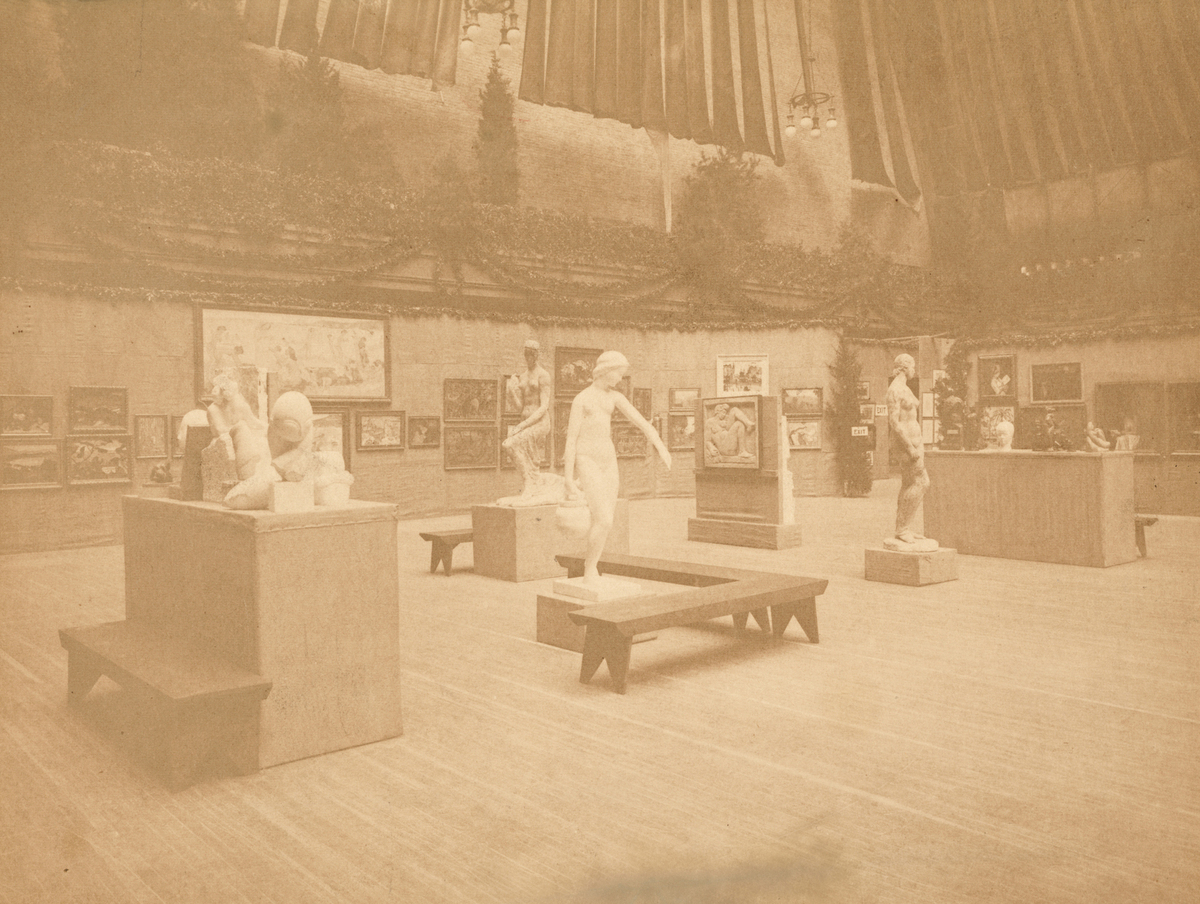
On Feb. 17, 1913, the International Exhibition of Modern Art opened at the 69th Regiment Arsenal on Lexington Avenue in New York. The Armory Show, equally it came to be known, had a profound outcome on American art.
Smithsonian Institution Archives of American Fine art
On Feb. 17, 1913, an art exhibition opened in New York City that shocked the land, changed our perception of beauty and had a profound event on artists and collectors.
The International Exhibition of Mod Art — which came to exist known, simply, as the Armory Bear witness — marked the dawn of Modernism in America. It was the outset time the phrase "avant-garde" was used to describe painting and sculpture.
On the evening of the show's opening, 4,000 guests milled around the makeshift galleries in the 69th Regiment Armory on Lexington Avenue.

Marcel Duchamp's Cubist-inspired Nude Descending a Staircase was famously described by 1 critic as "an explosion in a shingle manufactory." Philadelphia Museum of Fine art/Copyright succession Marcel Duchamp / ADAGP, Paris / Artists Rights Guild (ARS), New York 2013 hide caption
toggle caption
Philadelphia Museum of Art/Copyright succession Marcel Duchamp / ADAGP, Paris / Artists Rights Society (ARS), New York 2013

Marcel Duchamp's Cubist-inspired Nude Descending a Staircase was famously described past 1 critic as "an explosion in a shingle factory."
Philadelphia Museum of Fine art/Copyright succession Marcel Duchamp / ADAGP, Paris / Artists Rights Society (ARS), New York 2013
Two-thirds of the paintings on view were by American artists. Merely it was the Europeans — Van Gogh, Gauguin, Cezanne, Picasso, Matisse, Duchamp — that caused a sensation.
American audiences were used to seeing Rembrandts and Titians in their galleries — "a very realistic type of art," says Marilyn Kushner, the co-curator of an exhibition called "The Armory Show at 100" that opens in Oct at the New York Historical Society.
"If you saw a female person nude, in fine art, in sculpture or painting, it was very classical," Kushner adds. "And it was the thought of this perfect, classical beauty."
Kushner says it was jarring for audiences in 1913 to meet works such as Matisse'southward Blue Nude for the first time.
"Yous know, she's a nude. You tin tell she'due south a nude. But she's in all of these colors that you lot never imagined you would encounter on a woman before," she says. "She looks very primitive, nigh artless."
Viewers were shocked, Kushner says, "because they'd never seen anything like this before. And they didn't know how to relate to information technology."
Critics reviled the experimental art as "insane" and an affront to their sensibilities. Only the media attention drew crowds, and collectors took detect.
Matisse's Bluish Nude wound up at the Baltimore Museum of Art. Leah Dickerman, a curator at New York's Museum of Modern Art, explains The Red Studio, another Matisse from the show.
"You run across pictures piled up in the background, a bureau with another work leaning confronting it," Dickerman says. "But the walls of the studio, the floors of the studio, the table — anything that'due south non art, and not his composed still life, is done in a bright brick red.
"It's an extraordinary painting. The ruddy jumps, and yet, within that background, are all these brightly colored paintings and sculptural figures that are an inventory of things that Matisse made."

Marcel Duchamp, shown here with fine art historian Henri Marceau at the Armory Show 50th Anniversary Exhibition in 1963, painted the revolutionary Nude Descending a Staircase when he was merely 26 years old. Smithsonian Institution Archives of American Fine art hibernate caption
toggle explanation
Smithsonian Institution Archives of American Art

Marcel Duchamp, shown here with art historian Henri Marceau at the Arsenal Evidence 50th Anniversary Exhibition in 1963, painted the revolutionary Nude Descending a Staircase when he was simply 26 years erstwhile.
Smithsonian Establishment Archives of American Art
Dickerman says the works in the show had a profound effect on American artists. Merely nigh as remarkable was the exhibition itself. Information technology was organized past a grouping of ii dozen young artists who called themselves "The Association of American Painters and Sculptors." They raised money, generated publicity, transported the art, rented the Armory and staged the exhibition — all without public funding.
Historian Valerie Paley calls that revolution a countercultural moment that questioned the 19th-century vision of the world: "I think fine art historians are fond of thinking that it created a revolution."
Simply, Paley says, the artists' ingenuity was part of a bigger revolution.
"All sorts of extraordinary things are happening," Paley says of the mod age. "Albert Einstein is working on a new theory of gravity. New technology — electric lite, advice — only an explosion of 19th-century norms. And in New York, new buildings like the Woolworth Building or the M Primal Terminal — these are opening.
"It's a different fourth dimension. It'due south the dawn of a dissimilar time. And certainly this idea of deconstructing the onetime way of thinking — is very much in the air."
The nigh talked-about painting in the 1913 Arsenal Show deconstructed a human figure in abstruse dark-brown panels in overlapping motion. Marcel Duchamp's Cubist-inspired Nude Descending a Staircase was famously described by one critic as "an explosion in a shingle manufactory."
In 1963, on the 50th anniversary of the Armory Show, Duchamp was interviewed by CBS reporter Charles Collingwood. The audio is at present at the Smithsonian's Archive of American Fine art.

A notebook recording sales at the New York Armory Prove shows that Marcel Duchamp'southward Nude Descending a Staircase sold for $324. Walter Pach papers/Archives of American Fine art, Smithsonian Institution hide caption
toggle explanation
Walter Pach papers/Athenaeum of American Art, Smithsonian Establishment

A notebook recording sales at the New York Armory Show shows that Marcel Duchamp's Nude Descending a Staircase sold for $324.
Walter Pach papers/Athenaeum of American Art, Smithsonian Institution
When Collingwood asked Duchamp if he had realized that the piece would create "such a "furor," the artist responded: "Not the slightest. In the kickoff identify, I was a very immature painter, 26 years sometime. Never had been to America. Wasn't hither at the time."
Duchamp said he was in France when he got give-and-take that his painting had sold for $324. Later on the commission, he received $240 — about $v,565, in today's dollars. Cracking for an artist unknown in this country at the time.
Duchamp went on in the 1963 interview to say that, at the time, artists had lost the ability to surprise the public.
"In that location's a public to receive it today that did not exist then. Cubism was sort of forced upon the public to reject information technology. Y'all know what I mean?" Duchamp said. "Instead, today, any new movement is almost accepted earlier information technology started. Run across, there's no more element of shock anymore."
That'due south why the Armory Show was and then important in 1913, Dickerman says.
"Information technology'south this moment in time, 100 years ago, in which the foundations of cultural practice were totally reordered in equally great a style equally we take seen," she says. "And that this marks a reordering of the rules of art-making — it's as big equally nosotros've seen since the Renaissance.
"And I don't remember we've seen as great a transformation in the 100 years that follow — where the foundations of how art is conceived are totally shaken."
The 1913 Armory Show attracted 87,000 visitors in New York City before information technology traveled to Chicago, where critic Harriet Monroe saw it. She wrote in the Sunday Tribune, "These radical artists are right. They represent a search for new dazzler" and "a longing for new versions of truth observed."
Source: https://www.npr.org/2013/02/17/172002686/armory-show-that-shocked-america-in-1913-celebrates-100
0 Response to "Review Figure 1913 Which of the Following Statements Is True"
Post a Comment